
Table of Contents
1. Introduction to Cable Tray Selection
2. Structural Features of Three Main Cable Tray Types
3. Cable Tray Structure Comparison & Performance Data Analysis
4. Matching Cable Tray Types with Typical Cable Laying Scenarios
5. Practical Cable Tray Selection Principles
6. Industry FAQs
1. Introduction to Cable Tray Selection
Cable tray installation is a core part of electrical engineering layout. A wrong cable tray selection will not only reduce cable service life, but also cause hidden safety hazards and project rework.
Most engineering designers focus on load capacity and price only. They often ignore structural adaptability and scenario matching of different cable trays.
This guide focuses on ladder cable tray, perforated tray cable tray and solid cable tray. It provides professional structural comparison and scenario-based application advice to support accurate cable tray selection.
2. Structural Features of Three Main Cable Tray Types
2.1 Ladder Cable Tray
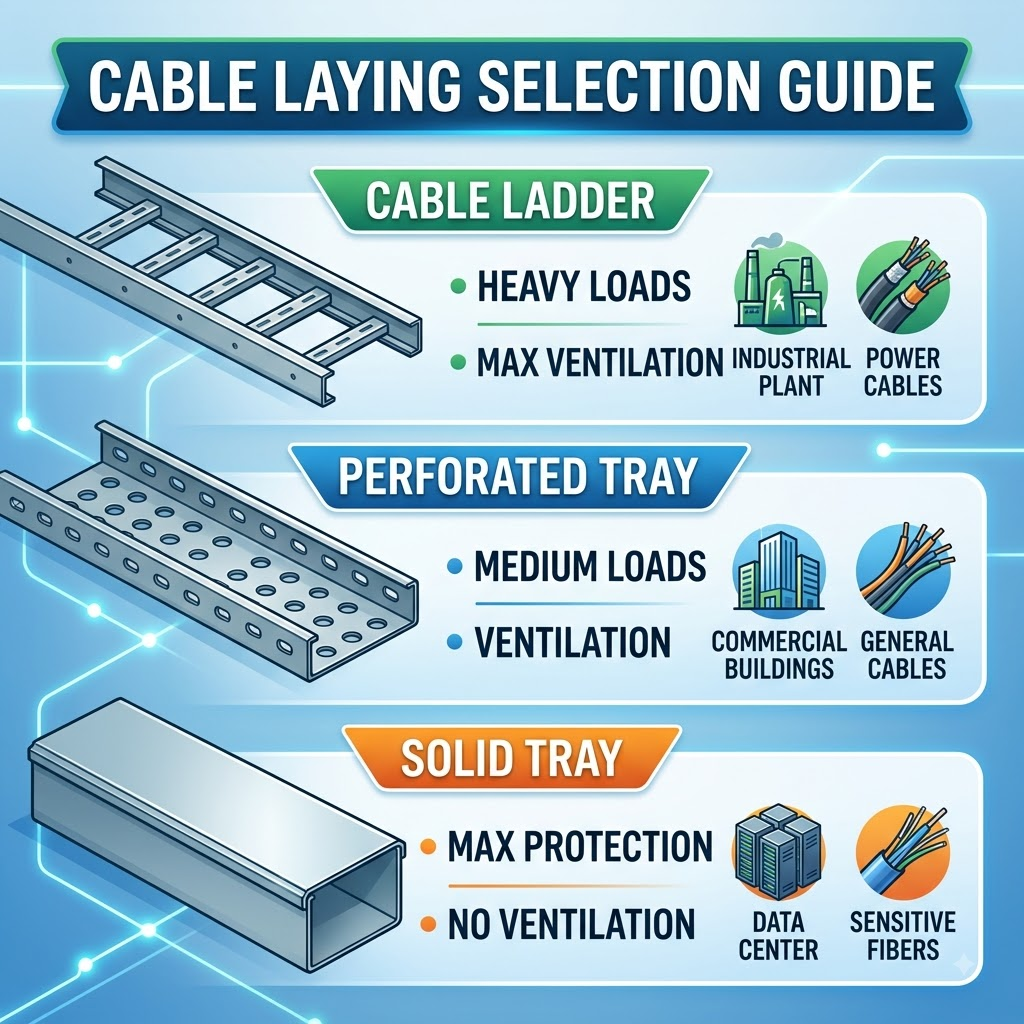
The ladder cable tray adopts a hollow ladder-style structure. It consists of two side rails and multiple horizontal support rungs.
This open structure brings excellent ventilation and heat dissipation performance. It also delivers superior mechanical bearing capacity.
It is lightweight and easy for on-site threading and daily maintenance. No closed shelter blocks operation space.
2.2 Perforated Tray Cable Tray
Perforated tray cable tray is a semi-closed structure with uniform punching on the bottom plate.
Different from fully open ladder trays, it provides basic dust protection. The punched design also ensures effective heat dissipation.
Its overall structure is stable and flexible. It is the most widely used cable tray type in general engineering projects.
2.3 Solid Cable Tray
Solid cable tray is a fully enclosed box-type structure with complete side plates and matching cover plates.
There are no holes or gaps on the tray body. It achieves full physical isolation for internal cables.
This structure has outstanding shielding, dustproof and splash-proof capabilities, but relatively poor heat dissipation.
3. Cable Tray Structure Comparison & Performance Data Analysis
The following verified industry data compares key indicators of the three cable trays, covering heat dissipation, load capacity, protection level and application proportion.
Performance Index | Ladder Cable Tray | Perforated Tray Cable Tray | Solid Cable Tray |
Structure Type | Fully open ladder structure | Semi-closed perforated structure | Fully enclosed box structure |
Heat Dissipation Level | Excellent (heat loss reduction 35%) | Good (heat loss reduction 22%) | General (heat loss reduction 8%) |
Average Load Capacity | High (max span 6m) | Medium (max span 4m) | Medium-High (max span 4.5m) |
Market Application Ratio | 28% | 62% | 10% |
Electromagnetic Shielding | Weak | Medium | Excellent |
Data shows perforated tray cable tray dominates general scenarios. Ladder trays suit high-load heat-dissipation demands. Solid trays are reserved for high-protection and anti-interference scenarios.
4. Matching Cable Tray Types with Typical Cable Laying Scenarios
4.1 Suitable Scenarios for Ladder Cable Tray
Ladder cable tray is mainly used for laying large-diameter high-voltage power cables.
It fits long-distance cable laying in power plants, substations and large industrial workshops.
Many engineers choose it for high-heat industrial environments, as open structure avoids heat accumulation.
4.2 Suitable Scenarios for Perforated Tray Cable Tray
This tray matches mixed laying of low-voltage power cables and control cables.
It is widely applied in commercial buildings, municipal engineering and ordinary factory workshops.
The balanced performance of heat dissipation and protection makes it suitable for most conventional cable laying scenarios.
4.3 Suitable Scenarios for Solid Cable Tray
Solid cable tray is the best choice for precision signal cables and communication cables.
It is commonly used in data centers, intelligent buildings and chemical dust-prone environments.
Its strong anti-interference ability can effectively prevent signal distortion of weak current equipment.
5. Practical Cable Tray Selection Principles
First, confirm cable type and laying environment. High-voltage heavy cables prioritize ladder trays. Weak current signal cables choose solid trays.
Second, check environmental factors. Dust, moisture or electromagnetic interference scenarios need closed or semi-closed structures.
Third, balance economy and performance. Perforated trays are cost-effective for most general projects.
6. Industry FAQs
Q1: Can ladder cable tray be used for weak current cables?
A1: Not recommended. Its open structure lacks electromagnetic shielding. Weak current signals are easy to be interfered, causing unstable equipment operation.
Q2: Why is perforated tray cable tray the most widely used?
A2: It balances heat dissipation, protection and cost. It can meet 60%+ conventional cable laying demands, with low maintenance difficulty.
Q3: Is solid cable tray necessary for indoor ordinary wiring?
A3: No. Indoor clean environments have no interference risks. Using solid trays will increase cost and reduce heat dissipation efficiency.