
Table of Contents
1. Why Dense Busbar Trunking Is Gaining Attention
2. The busbar supply chain
3. Comparing distribution approaches
4. Standards and documentation
5. Industry case: data-center expansion
6. How buyers compare suppliers
7. Where the market is heading
8. Frequently Asked Questions
9. Plan Your Busbar Sourcing Review
Why Dense Busbar Trunking Is Gaining Attention
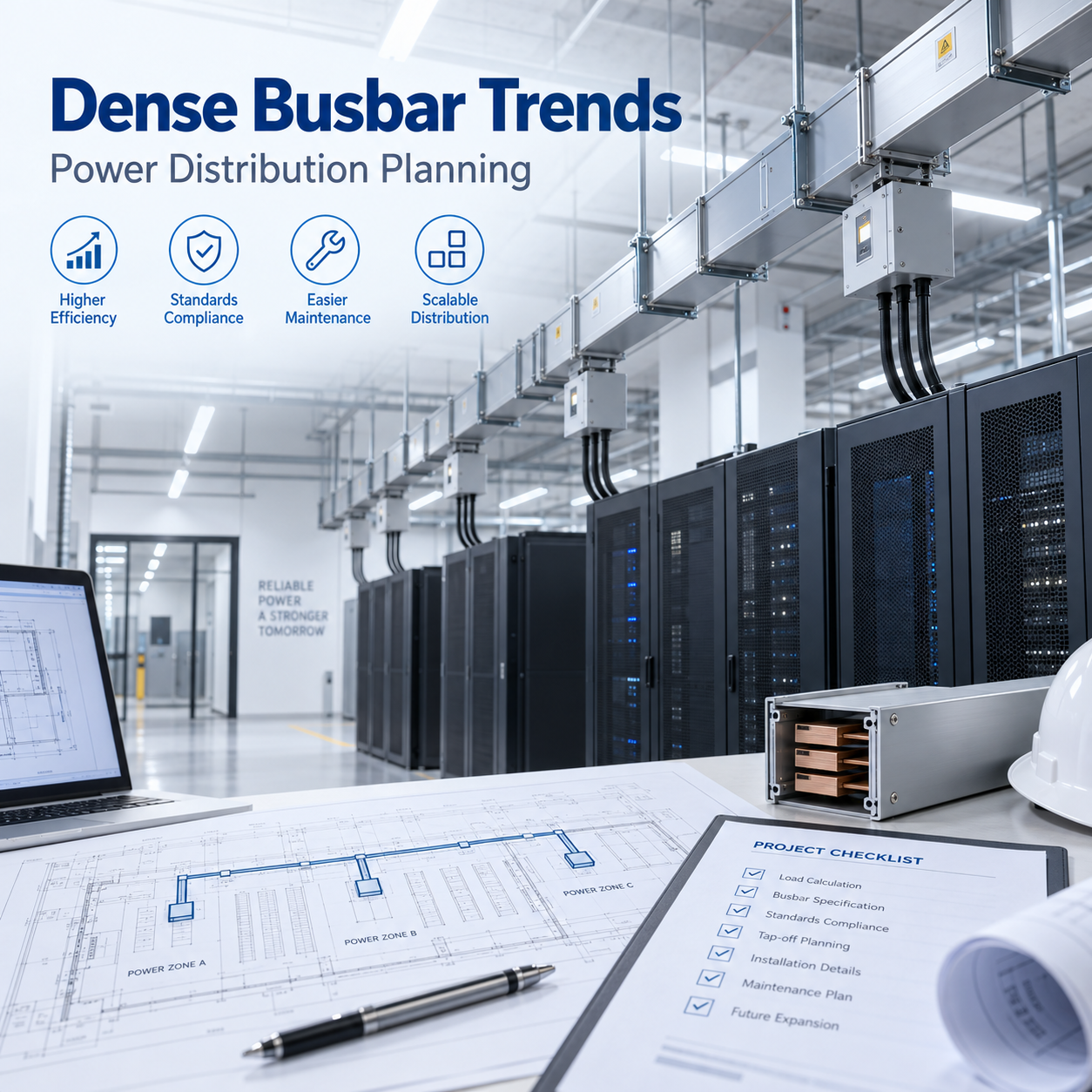
HDCMC Dense Busbar Trunking System is designed for projects that need compact, organized power distribution rather than long runs of separate cables. Zhenjiang Hengdi Intelligent Electric Co., Ltd. describes HDCMC as a dense busbar system using copper or aluminum conductors with an aluminum-alloy enclosure. Its busbar range covers rated currents from 16 to 6,300 A across catalog families, with joints, tap-off units, bends, terminations and installation layouts selected by route, poles and current.
Industrial plants, commercial buildings and civil projects are asking for power distribution that is easier to coordinate with structure, equipment and maintenance access. Dense busbar trunking answers part of that need by placing conductors in an enclosed route and allowing planned connections along the system.
The decision still depends on current, voltage, fault level, fire requirement, route length and installation environment. ‘Dense’ is not a substitute for a design calculation or a complete accessory schedule.
The busbar supply chain
A busbar project links conductor material, insulation, enclosure, joints, tap-off units, bends, terminations, supports and test documentation. A change in current or pole arrangement can affect every item. That is why the route drawing and load schedule should be released together.
Hengdi’s catalog distinguishes dense, high-strength, air-insulated, fire-resistant and engineered busbar families. Buyers should select the family after reviewing the duty and applicable project requirements, not only by the shortest product name.
Comparing distribution approaches
Approach | Strength | Risk to manage | Typical fit |
Separate cable feeders | Flexible routing | Space, support and identification burden | Retrofit or irregular routes |
Dense busbar trunking | Compact enclosed route and planned tap-offs | Needs accurate route and joint schedule | Industrial and commercial distribution |
Air-insulated busbar | Service-specific construction | Clearance and environmental conditions | Selected enclosed systems |
Fire-resistant busbar | Designed for critical circuits | Performance must match test documents | Emergency or fire-rated routes |
This comparison is a planning lens. Confirm current, fault level, protection, fire requirement and installation conditions for the real project.
Standards and documentation
The website states that ISO 9001 quality-system certification and CCC and type-test reports are available for busbar systems. A purchaser should request current documents and confirm which report applies to the selected family, current range and configuration.
The project file should include conductor and enclosure details, joint and tap-off drawings, insulation and clearance requirements, protective-earth continuity, routine tests and final marking. Documentation is part of system handover, not an afterthought.
Industry case: data-center expansion
A data-center expansion may require a defined route from a main switchboard to several distribution points. The engineering team must reserve space for bends, joints, tap-offs and future maintenance. A dense busbar system can be considered when the current and protection requirements fit the selected family.
The useful lesson is coordination. A route that is compact on paper can be difficult to install if support spacing, access panels or tap-off orientation is not shown. Early layout review reduces site changes.
How buyers compare suppliers
Ask which busbar families are available, how conductor material is selected, what type-test documents can be supplied, how joints are inspected and how route accessories are engineered. Request a bill of materials tied to the route drawing.
Compare lead time on a complete scope. Straight sections without bends, supports, terminations or tap-offs do not represent an installable system. Clarify packing marks and delivery sequence for each route section.
Where the market is heading
Power distribution projects are moving toward modular route planning, clearer digital drawings and better lifecycle records. Standardized tap-off positions and documented joint details make expansion and maintenance easier. The supplier’s role is to turn those requirements into a controlled system that can be installed and verified.
For every busbar project, keep one controlled package containing the route drawing, conductor choice, rated current, pole arrangement, enclosure, joint and tap-off schedule, protection requirement, test documents, installation notes and delivery sequence. This helps design, procurement, installation and maintenance teams work from the same information. A clear package also makes later expansion easier because the installed system can be identified before a new feeder is added. Before release, check the real installation path. Confirm ceiling height, wall penetrations, shaft dimensions, support spacing, fire compartments, expansion joints, access panels and the lifting route for each section. A straight length may fit the electrical drawing and still be impossible to move through a plant room door. Bends and tap-offs should be positioned where the load schedule requires them, not where they are easiest to draw. For copper and aluminum options, review current, voltage drop, temperature rise, weight, joint design and maintenance practice together. The enclosure and protective-earth arrangement should be consistent through straight sections, joints and terminations. At the factory, agree which dimensions are checked before dispatch and which tests are included in the dossier. At site, identify every section and compare it with the route drawing before installation. Record torque values, joint checks, insulation or clearance checks and protective-earth continuity according to the project plan. These records help commissioning and make future troubleshooting faster. When an expansion is planned, retain the original series, current rating, pole arrangement and accessory schedule. That information prevents an incompatible tap-off or bend from being ordered later. Good busbar sourcing is therefore a combination of electrical design, mechanical coordination, documentation and practical installation planning. The HDCMC name is a useful product reference, but the route and load data remain the basis for a dependable system.
When comparing quotations, make the scope visible. List straight sections, joints, tap-off units, bends, terminations, supports, end caps, shipping marks and documents as separate lines. Confirm whether installation hardware, lifting accessories and commissioning support are included. Ask how a change in route or current will affect the bill of materials and lead time. For a remote project, request photographs of packing and section labels so the installer can match each package to the drawing. If a component is damaged in transit, clear marks and inspection records make the claim and replacement process easier. These details may seem ordinary, but they prevent the most common busbar project delays: missing accessories, wrong orientation, unclear section numbers and unplanned site modification. A complete quotation is easier to approve and easier to install.
This reference also supports maintenance planning and future system extensions. It keeps the original route information available for commissioning and audits.
Frequently Asked Questions
This makes future troubleshooting and expansion faster for plant teams.
What is an HDCMC Dense Busbar Trunking System?
It is a compact busbar trunking family with copper or aluminum conductors and an aluminum-alloy enclosure. The exact current, poles, protection and accessories are selected for the route.
What rated current is available?
The website states that its busbar catalog families cover 16–6,300 A. Confirm the selected HDCMC configuration and project conditions before design release.
Can copper and aluminum conductors be selected?
Yes. The HDCMC page lists copper and aluminum configurations. Selection should consider current, voltage drop, temperature rise, weight, joint design and project requirements.
Which accessories are needed?
Joints, tap-off units, bends, terminations and installation layouts are selected according to series, current, poles and route. Include the route drawing in the inquiry.
Plan Your Busbar Sourcing Review
Send the route, load schedule, current, poles, fire requirement and documentation needs to Zhenjiang Hengdi Intelligent Electric Co., Ltd. A structured review can clarify HDCMC and other busbar family options.